From wastewater engineering to riding the waves, my Social Fellowship with EcoSwell was a journey of purpose, learning, and connection.
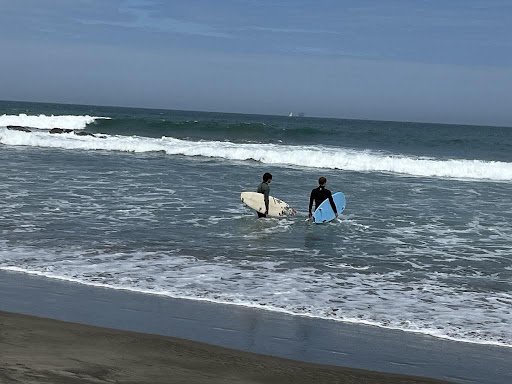
Maik with another volunteer going for a surf in Lobitos
Why did I apply as a Social Fellow? - For me, the decision was driven by three pillars: impact, adventure, and personal passions. I always believed that everyone carries a responsibility to make a difference, no matter how small. Confronted with global challenges such as climate change; I wanted to contribute in a way that feels tangible—helping to build a more sustainable future and supporting vulnerable communities.
Being part of Lobitos was eye-opening. The local perspective on life is refreshingly different, and being welcomed by the community was a privilege. Plus, I discovered the best ceviche I’ve ever tasted! On a personal note, the fellowship allowed me to pursue my passion of surfing.
Why EcoSwell?
First and foremost, EcoSwell impressed me with its professionalism and deep expertise in improving the quality of life of vulnerable communities in northern Peru. The founders are highly qualified, and the organization collaborates closely with international universities like Newcastle and Lancaster. I wanted my efforts to have real impact, and EcoSwell’s approach—combining hands-on work with innovative technology—was exactly what I was looking for. As a mechanical engineer by training, I was also able to actively contribute my skills, for example through technical drawings.
Beyond the professional fit, EcoSwell’s team culture resonated strongly with me. As the name suggests, the organization shares my passion for surfing (“swell” refers to wave energy). Surf sessions with colleagues fostered a unique team spirit, making the experience both meaningful and personally enriching.
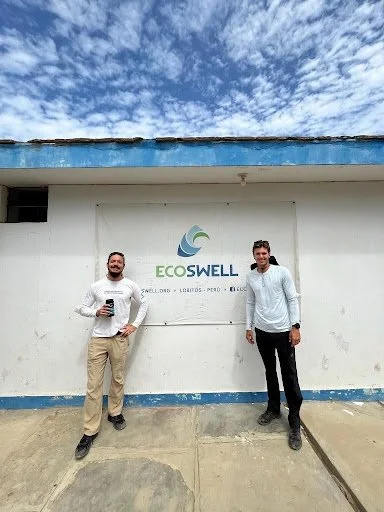
Maik with EcoSwell Director Diego ready to go do fieldwork
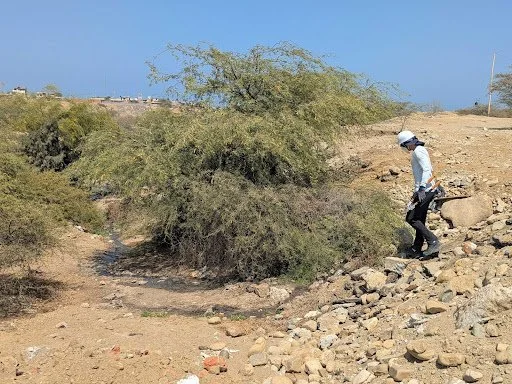
Visiting the potential site for the Biodigestor installation
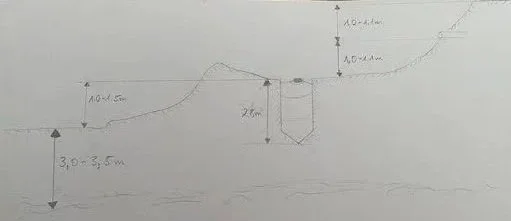
Sketch of landscape and Biodigestor positioning for the project implementation
What did I work on?
I joined the Water & Sanitation team of Ecoswell focusing on improved wastewater management in Lobitos, where a centralized sewage system is non-existent. Given the high cost and complexity of traditional sewage infrastructure, we leveraged a simpler solution: biodigesters. These are buried tanks that treat domestic wastewater (black and greywater); the liquid is given a primary treatment by bacteria for a given retention time and then further filtered into the ground, while the sediments settle and remain in the tank before being periodically removed through a pipe and a valve to let dry and use as fertilizer later. My project spanned the entire process – from site selection (Lobitos has more than 10+ critical wastewater spills!), through technical feasibility assessments to a step-by-step implementation guideline, incl. technical drawings.
Note: At the EcoSwell House in Lobitos where I stayed, we use a similar approach daily with a dry composting toilet. The resulting compost was used as fertilizer during community “Planting Days”, where we planted trees with local families.
What was my most important learning?
Taking ownership and making decisions with limited resources and uncertainty. We often had to make pragmatic yet diligent choices without full information. These decisions directly affect the sustainability and the lasting impact of the projects.
A concrete example: determining the size of the biodigestor tank. Ideally, we’d have used advanced technology like smart meters to accurately measure wastewater flow. Local representatives couldn’t provide exact numbers of households connected to each pipe, and water usage varied widely. We took multiple samples at different times, but it was still an estimate.
Accepting responsibility for these decisions and living their consequences was a powerful lesson in responsibility and adaptability. I am confident to carry these learnings into my consulting work where time pressure, data gaps, and resource constraints are similarly common.
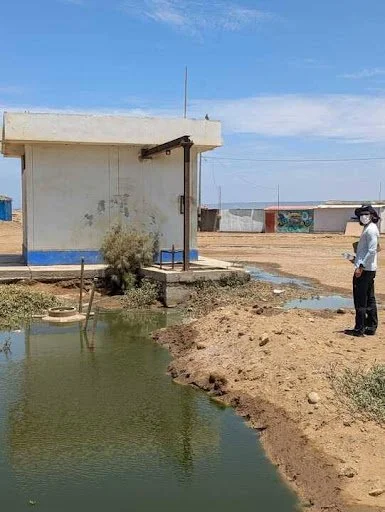
Analyzing wastewater spills around Lobitos
What did a typical day look like?
Most days started with a slow morning: surfing, yoga, or reading from 6:00 to 8:30 a.m. After breakfast in the sun, we worked together in the EcoSwell House (all volunteers lived and worked there) until 5pm. Regular duties included shopping at the local Talara market and maintaining the dry toilet. Evenings were reserved for breathtaking sunsets followed by Spanish lessons, yoga, or cooking with fellow volunteers. By 9:00 p.m., it was usually time for bed.
True to EcoSwell’s “Let your people surf” philosophy, we sometimes swapped work hours for surf sessions, depending on the waves and the amount of workload.
What did I enjoy most?
Living in sync with nature—daily sun and sea were a real energy boost and felt incredibly natural. The minimal outside influences made it easy to truly unwind. Working directly with local people meant seeing the impact of our efforts firsthand. It was an incredibly memorable experience that I will never forget and has helped me forge some new perspectives for my own professional career. Thank you EcoSwell!
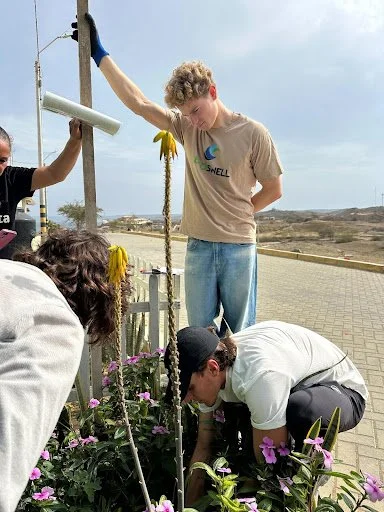
Maik and Magnus during our Wednesday Planting days with families